

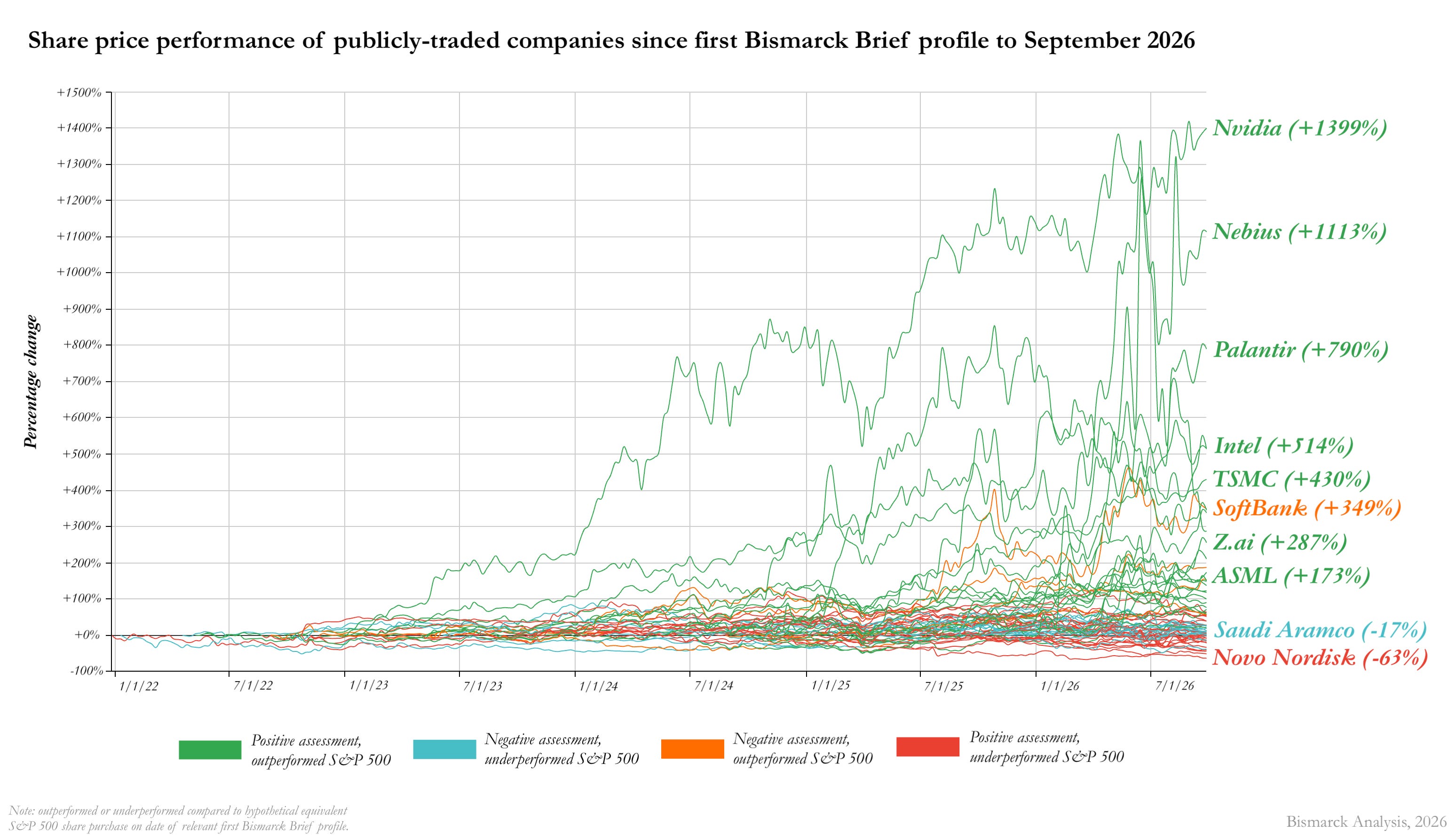
In just a couple weeks, we will issue the 250th Bismarck Brief. This is the fourth year we can evaluate the Briefs like a data set of their own, allowing us, to a degree, to evaluate our own analytic performance. One interesting and easily-answered question is: what happens to the stock prices of publicly-traded companies after they are profiled in Bismarck Brief?
Above is a graph of the share price performance of every publicly-traded company covered in Bismarck Brief—all 74 of them, give or take—since the date it was covered to September 28, 2026. Bismarck Brief is not financial or investment advice (see full disclaimer below). But, generally, a positive assessment of institutional functionality or live player strategy in the context of business will eventually be reflected by the wider markets as well, as the fruits of such functionality become widely recognized.
If one had invested the same amount of funds into each company that Bismarck Brief positively assessed on the date the corresponding Brief was published, one would have invested 53 times and the total investment would have grown by +146%. Had one instead invested into the S&P 500 the same number of times on those same dates, it would have grown only +51%, a nearly three times lower rate of return. Had one taken the same total amount of invested funds and instead put them into the S&P 500 all at once when Bismarck Brief began publishing, then left them alone, the total investment also would have grown only +61%.
The most striking empirical outcome, however, is that if one had invested the same amount of funds only into the 27 publicly-traded companies Bismarck Brief evaluated specifically as live players, one’s total investment would have grown a staggering +205%, compared to just +60% for the equivalent investments into the S&P 500.
For several years, the attention of many of the world’s live players has been intensely focused on the development of artificial intelligence technology, which itself relies on the global semiconductor industry. Bismarck Brief has been investigating live players in semiconductors and AI since 2022—four years now—and, if one had invested the same amount of funds only into the 28 semiconductor and AI-related companies covered by Bismarck Brief, one’s total investment would have grown an even more staggering +233%, compared to just +49% for the equivalent investments into the S&P 500. Such figures suggest the attentive Brief reader is well upstream of the passive market investor.
The Brief only evaluates institutions that are plausibly strategically important, so the decision to profile a company at all means it is worth attention, whether or not its valuation subsequently grows or declines. If one had invested the same amount of funds into each company Bismarck Brief covered, whether positive or negative, one would have invested 74 times and the total investment would have grown by +116%, compared to +51% for the equivalent investments into the S&P 500.
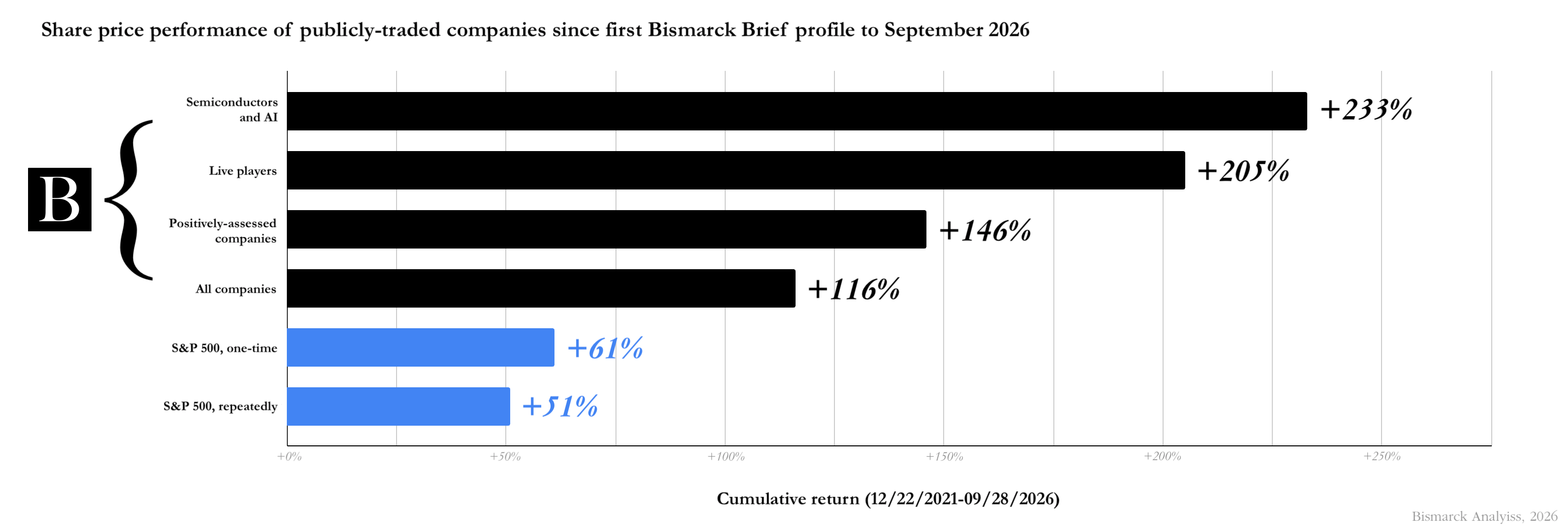
Every investment strategy is necessarily far more idiosyncratic and developed in practice than this simple thought experiment. But this shows that Bismarck Brief can provide a unique and useful perspective for investors that is upstream of markets, even though our focus is exclusively on investigating the structures of institutions and strategies of live players.
Bismarck Brief wrote and issued in-depth investigations of multiple of the best-performing publicly-traded companies of recent years immediately prior to meteoric rises in their stock prices. Our Brief on Nvidia was sent to our paid subscribers on December 14, 2022. Since then, Nvidia’s share price has grown an incredible +1399%. Our Brief on Palantir was sent on May 15, 2024. Since then, Palantir’s share price has grown +790%. Our Brief on Meta was sent on February 15, 2023, during a low point of market expectations for the company’s future and strategy. Since then, Meta’s share price has grown +338%. Once is a fluke. Twice is a coincidence. But three or more times is the indication of valuable knowledge.
Nvidia is an extreme positive outlier. But so was the Brief’s exceptionally positive assessment of Nvidia’s technological leadership. The Brief concluded:
[...] insofar as the computationally intensive deep learning model of AI is the most promising to usher in an AI revolution in technology and industry, Nvidia is one of the most promising companies poised to benefit from it.
Jensen Huang has shown an ability to undertake long-term, highly risky changes in strategy and achieve a massive payoff that places Nvidia at the center of a very promising market and justifies its enormous valuation. Increased governmental constraints through antitrust and export controls constrain Nvidia’s future vertical integration, but should not hinder its expansion based on its current model, so long as demand for powerful GPUs and other chips continues to increase. Nvidia’s enviable position is leading many would-be competitors to challenge it, but so long as Jensen Huang proves to be a live player while in charge of the company, Nvidia will probably be capable of weathering any competition, whether by simply outcompeting established giants or buying out small startup challengers.
Similarly, the Brief was exceptionally positive about another positive outlier, Palantir, concluding that:
Under Karp, Palantir has been a live player. At 56 years old, Karp is unlikely to leave the company anytime soon, but is rather in the midst of a years-long and successful strategy to grow the company’s commercial client base under “unrelenting demand,” in Karp’s own words. In 2018, Palantir hired its first-ever salespeople and Karp described the company as “going into adolescence.” In the fourth quarter of 2023, Palantir reported a profit for the first time. The company is likely to derive more revenue from commercial clients rather than government ones for the first time ever in the next few years. For both types of clients, Palantir’s provision of fundamental organizational and decision-making software, as well as the necessary expertise to maintain or update it, means that Palantir will, over time, become a difficult-to-displace incumbent that benefits from institutional inertia. So long as Palantir itself remains lean and maintains its unique brand, this will also likely result in high margins.
Many have an instinctive resistance to the idea that the greatest financial returns accrue from just a few bets that, years down the line, become perceived as obvious in hindsight. There is a sense that it couldn’t be, or shouldn’t be, so simple. Yet careful observers of both startups and stock markets have long known that the most outsized financial returns always come from just a tiny few paradigm-shifting companies led by live players. It was not luck that determined that Bismarck Brief would investigate Nvidia or Palantir before these companies captured the attention of the world’s investors, but our methodical investigation of the organizations making the world’s most dazzling technological advances possible.
Day in and day out, the team behind Bismarck Brief tirelessly searches for the world’s most technologically and strategically impactful companies, and the live players behind them. I warmly invite those who wish to know the results of our search, in detail and every Wednesday at 2pm GMT sharp, to become paid subscribers today:
It is impossible to ignore that the single biggest story by far in both technology and investing since the release of ChatGPT in late 2022 has been AI and the semiconductor industry that powers it. As of late 2026, companies not just like Nvidia, but also Intel, TSMC, and ASML have become household names, at least in certain tech and finance circles. Much of the stock price performance of companies profiled in Bismarck Brief comes from the fact that they are semiconductor or AI-related companies, which Bismarck Brief not infrequently investigated not months but entire years before they became “priced in.”
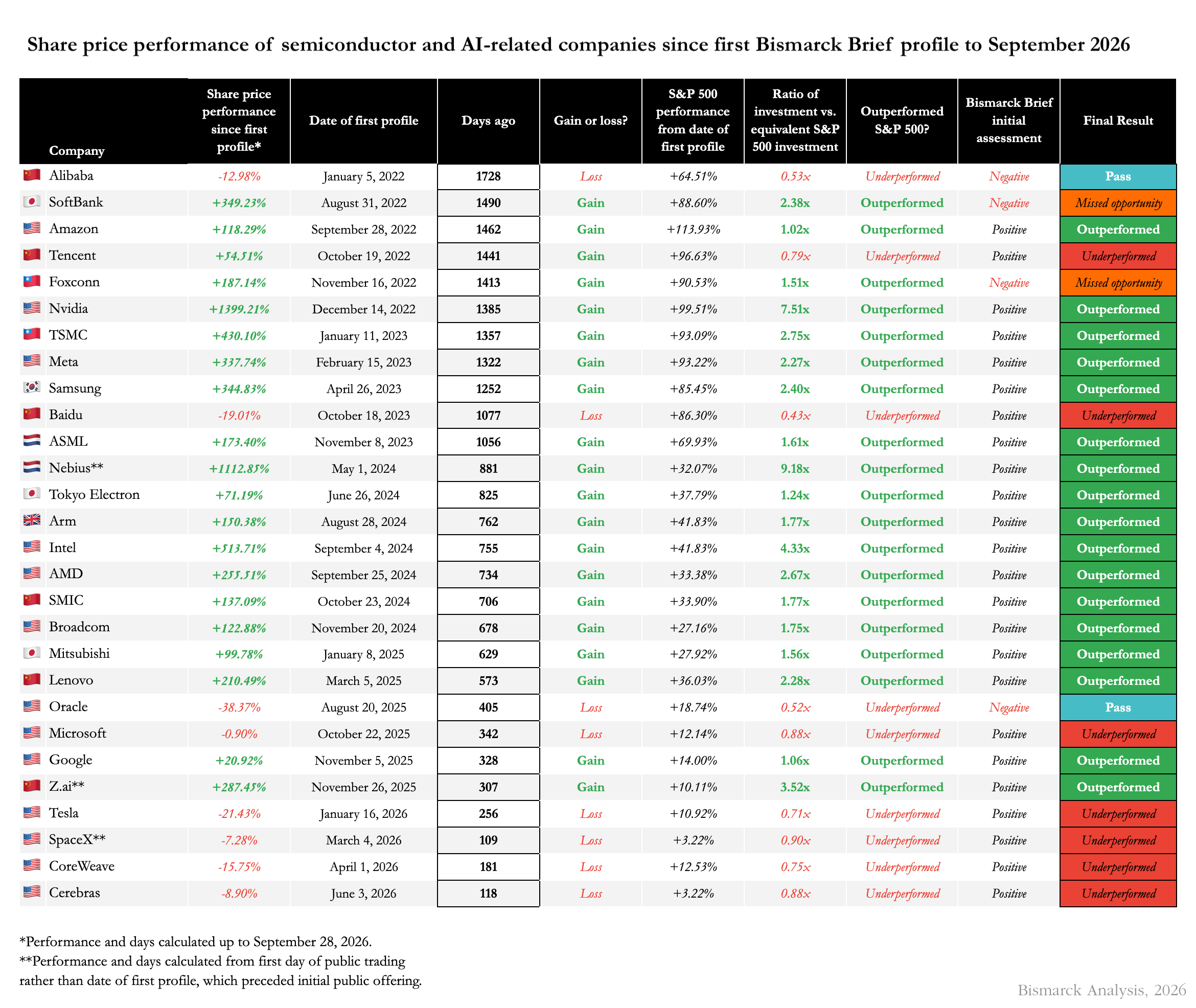
Our Brief on Nvidia was so early it was released not more than two weeks after ChatGPT itself was made available to the public. Then we issued our first Brief on the world’s foremost semiconductor foundry and Nvidia’s key manufacturing partner, Taiwan’s TSMC, a few weeks later in January 2023. It is since up +430%. That company’s closest competitor is South Korea’s Samsung—our Brief on Samsung was issued a few months later in April 2023. It is since up +345%. Both companies are totally reliant on advanced photolithography machines made by one company: the Netherlands’ ASML, on which we issued a Brief in November 2023. It is since up +173%.
By the end of 2024, we had issued Briefs on Tokyo Electron (+71%), Arm (+150%), Intel (+514%), AMD (+256%), SMIC (+137%), and Broadcom (+123%). In our Brief on Yandex from May 2024, which we assessed as a live player during the time its founders were in control, we even noted that while one founder was deceased and the other forced out of the company by the Russian government, this latter founder was taking his fortune, much of the company’s best talents, and some of its most advanced AI projects to the Netherlands to potentially reinvent his company. One of the projects we noted is now one of the world’s best-known “neoclouds,” Nebius. It is up +1113% since then. In late 2025, we began a systematic study of China’s top AI labs. We published our Brief on Z.ai, the company behind the GLM family of AI models, in November 2025. It went public in January 2026 and jumped some sixteen times its initial price in six months, though it is now up only a comparatively paltry +287%.
Bismarck Brief is not a semiconductor or AI newsletter per se. In fact, all of the semiconductor and AI-related Briefs we have ever issued combined would be just a fraction of our total output, which covers literally the entire global strategic landscape in all its facets, be they technological, economic, political, ideological, scientific, or cultural. Nor have we yet exhausted the list of all possibly relevant semiconductor or AI companies. Nor, for that matter, have we deliberately focused on semiconductor companies that can be traded—one of our most important and widely-read semiconductor Briefs was on the German optics company and key ASML supplier Carl Zeiss, which has been foundation-owned for generations.
But, through our methodical, theory-driven approach, based on the principles of Great Founder Theory, we were able to turn our attention to the most important companies such as Nvidia, TSMC, Intel, Samsung, or ASML—and explain their significance to our readers—years before they became “priced in” by everyone else. In fact, much of the boom is simply in downstream suppliers to Nvidia, which we covered in late 2022: one could have easily and logically invested not just in Nvidia but its suppliers too. Once again, the most important story in investing is largely the handiwork of a single live player, namely Jensen Huang. This, more than anything, is the wonderful vindication of our approach that I am pleased to see. I hope our readers ask themselves: what Briefs am I reading on live players and companies today that, in two, three, or four years’ time, everyone else will suddenly be talking about? With Bismarck Brief, we aim to send you breaking news years before it is published.
Compared to when we performed the same analyses of stock price performance in 2023, 2024, and 2025, Bismarck Brief has not just consistently outperformed, but performed better and better every year. In 2024, we found that the sum of investments and returns on investment of investing in live players profiled in the Brief were 1.56x of the equivalent for the repeated same dates or one-time investment into the S&P 500—whichever is greater that year, for comparison’s sake—while in 2025 they were 1.84x greater and, in 2026, they were 1.89x greater. The figures for positively-assessed companies grew from 1.19x in 2023 to 1.53x in 2026, while for all profiled companies the figures grew from 1.12x to 1.34x. Bismarck Brief has beaten the S&P 500 every year, beaten it harder every year, and beaten it harder the more positively and confidently we assess a company every year.
Bismarck Brief is not financial advice. It is not intended to be, nor will it ever be. The Brief researches and analyzes the fundamentals of institutional structure, leadership, and strategy, sometimes for publicly-traded companies, but also for every other kind of key institution, whether it is a private company, government bureaucracy, nonprofit foundation, family office, defense contractor, media outlet, microstate, or something else. These institutions, and the specific and unique people behind them, are the discrete forces that make up what we call “fundamentals.”
Markets do not care about fundamentals themselves. The valuations of public companies are driven by the capricious swings in the collective moods of retail and also institutional investors—the widespread adoption of metrics like ESG demonstrates that political considerations play a significant role as well. The market itself is a dead player, whose expectations are routinely surprised and outmaneuvered by live players. Returns come not from aligning with the consensus of passive investors, but by aligning with live players who successfully change that consensus.
The methodical and careful application of our unique theory can help investors ground intuitions and set expectations of the future so they too can think like live players. The legendary investor George Soros famously viewed his investing strategy as popping the epistemic bubbles of false but widespread beliefs. Such a feat necessarily requires the unique knowledge, social information, and final judgment of an individual investor. But to evaluate a belief as false, one must first have a solid grounding in true fundamentals. In this way, Bismarck Brief can crucially help investors, much in the same way as it provides a strategic perspective to companies, philanthropists, and governments.
What does the future hold for us a few years from now? In recent months, Brief subscribers have received in-depth investigations on SpaceX’s Starlink satellites, Meta’s frontier AI lab, the vital importance of neoclouds to AI startups, Masayoshi Son’s alliance with Sam Altman and OpenAI, the enormous AI chips of Cerebras, potential great leaps in brain-computer interfaces, China’s cheap humanoid robots, new oil drilling methods, Britain’s last inventor, Chinese memory chips, the rapid roboticization of ground warfare, and the potential of light-based computing. There is more to come and, personally, I have no doubt that we are more likely than not to be thinking about these same topics years from now. Why wait to get informed?
If you are not already a paid subscriber to Bismarck Brief, I warmly invite you to subscribe today and join us on this ongoing investigation into the global power landscape:
I wish all our readers and supporters a warm and pleasant fall season!
Sincerely,

Samo Burja
Founder and President, Bismarck Analysis